
SARJ Speech Models: Built for Voice Agents
Arabic, English and Urdu speech models, with vocabulary hints, conversational context, end-of-turn detection and expressive voices.

Voice agents live or die on the first step: hearing the caller correctly. On our calls that means Gulf Arabic, English dropped into the middle of Arabic sentences, and names of clinics, products and streets.
So we built our own. SARJ STT recognizes Arabic, English, Urdu and mixed speech, and it was trained and evaluated on real call audio. This post shows what it does well, where it still falls short, and how we measured both.
A recognizer for a voice agent has four jobs. It has to be fast, because every millisecond is silence on the line. It has to be right on the speech the agent actually hears. It has to accept help: the agent usually knows which names might come up and what it just asked. And it has to know when the caller has finished. The sections below take these in turn.
The numbers were measured as each capability was built. Where an evaluation setting differs from the live streaming service, we say so.
Fast enough to hold a conversation
SARJ STT is a streaming model: it transcribes while the caller is speaking and revises as more audio arrives. In load tests with 12 calls sharing one GPU, the final transcript was ready about 110 milliseconds (median) after the service detected the end of the turn. Turning on every option described below keeps it under two tenths of a second.
On public speech benchmarks
On the six sets of the open Arabic ASR leaderboard, scored with its own scorer, SARJ STT averages 22.00% word error rate, and 4.77% on English.
Word error rate by test set · lower is better
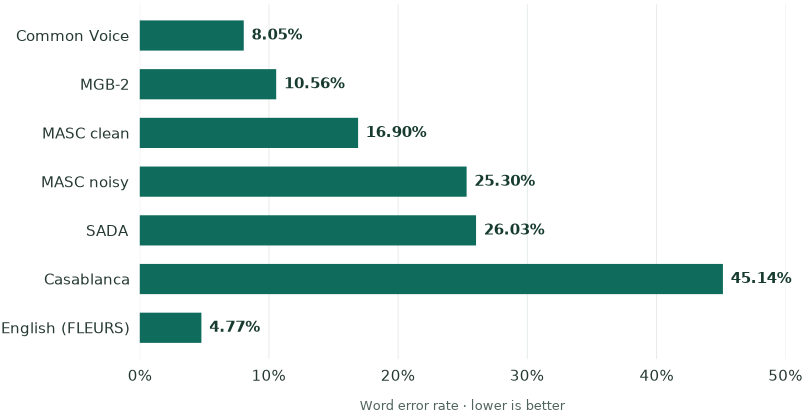
These scores use offline decoding with 13-frame look-ahead for Arabic. The one-frame bilingual offline evaluation scores 23.07% Arabic WER; the streaming service uses one-frame look-ahead. English is measured separately.
Results track the difficulty of the speech: read speech is easiest and dialect-heavy conversation is hardest. Casablanca is where we have the most room to improve.
The datasets use different transcription conventions: numbers appear as words or digits, spellings such as مرة and مره vary, and English words may use Latin script or Arabic transliteration. Official normalization does not reconcile all of these choices, so WER can include writing mismatches alongside recognition errors. We retain the leaderboard’s official scoring above.
Urdu recognition · two public benchmarks
| Evaluation set | WER |
|---|---|
| Common Voice Urdu | 21.85% |
| FLEURS Urdu | 19.66% |
Offline recognition evaluations.
Recognition on private evaluation data
We compared SARJ STT with five other recognizers on a private evaluation set: 953 clips from 268 recordings, 4.0 hours of mostly Gulf Arabic with English and mixed-language clips. Every system was scored with the same normalization to reduce penalties for equivalent spelling and formatting.
Private evaluation set · word error rate · lower is better
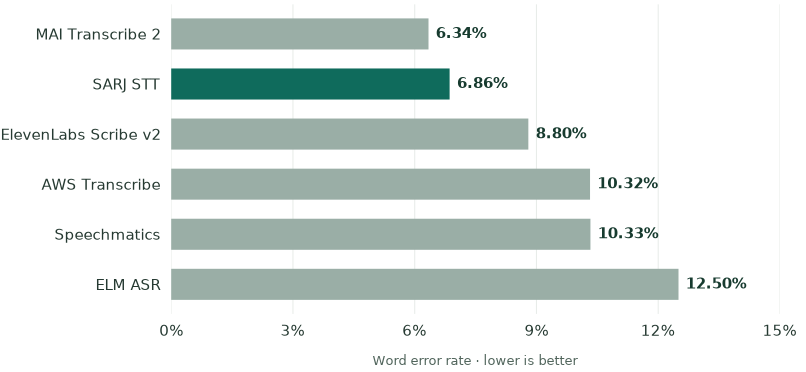
Private evaluation set · 953 clips · 4.0 hours. Arabic, English and mixed speech, scored with one shared normalizer. AWS used Arabic–English language identification; Speechmatics used its Enhanced Arabic–English mode.
SARJ STT scores 6.86% WER, compared with 6.34% for MAI Transcribe 2 on this set.
Vocabulary hints
Names are where recognizers fail first. A branch, a medicine or a street may be said once in a call, and no amount of general training covers them all. So a call can hand SARJ STT a list of up to 50 keywords that might come up.
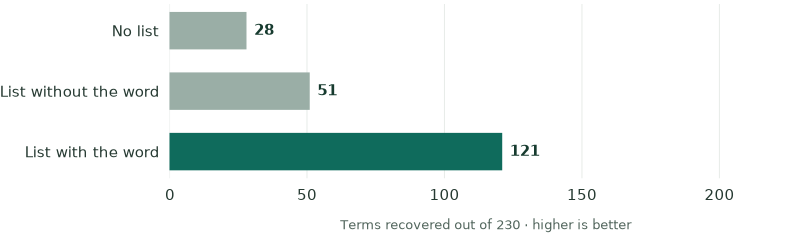
We tested this on 230 rare terms. With the right word on the list, the model recovered it about four times as often as with no list.
Rare-word recovery · 230 targeted terms
A place name, with and without a hint
| Spoken | Without hints | With hints |
|---|---|---|
| فرع عنيزة متى يقفل؟ | فرع عنيز متى يقفل؟ | فرع عنيزة متى يقفل؟ |
When does the Unaizah branch close?
From our evaluation · the 50-term list includes عنيزة.
Two cautions. Short, relevant lists work best: on a separate panel of 287 difficult terms, the model recovered 132 with a 15-term list and 100 with a 50-term list. And a hint is a nudge, so about one turn in a hundred with a list contains a listed word that was not spoken.
Understanding the reply in context
“The second one.” “No, the other branch.” Replies like these are hard to transcribe alone and easy once you know the question. An agent can pass its last message along with the caller’s audio.
We measured this on a second private set of 1,178 call clips, a much harder one than the first, which is why the error rates are higher. Passing the agent’s message reduced WER from 29.62% to 27.89%. It has to be the real last message: a wrong one can make recognition worse than none.
A reply, with and without the agent’s message
| The agent had just said | Heard alone | Heard with the agent’s message |
|---|---|---|
| بالنسبة لمطار الدوادمي ما عندنا فرع هناك، تقدر تختار أقرب فرع يناسبك | نفس المدينة، مدينة جواد بن، هل يوجد فرع؟ | نفس المدينة، مدينة الدوادمي، هل يوجد فرع؟ |
The caller asks whether there is a branch in the city of Al-Dawadmi, which the agent had just named.
From our evaluation · same audio in both columns.
Knowing when the caller is done
An agent that answers too early interrupts; one that waits too long feels slow. The same service returns an end-of-turn estimate, computed from the speech features it already has, so an agent can start preparing its reply during the caller’s pause. It adds tens of milliseconds.
We compare it with LiveKit’s multilingual models on public Arabic and English data, and on a private set of 3,914 pause decisions from our calls.
End-of-turn detection · AUC · higher is better
| Evaluation set | Pauses | SARJ EOU | LiveKit Full | LiveKit Mini |
|---|---|---|---|---|
| Public Arabic | 963 | 0.890 | 0.945 | 0.853 |
| Public English | 1,105 | 0.922 | 0.969 | 0.890 |
| Private evaluation set | 3,914 | 0.825 | 0.700 | 0.584 |
EOU evaluated with the previous agent message as context. The public Arabic set is mostly Egyptian.
The pattern is the same as for recognition. LiveKit Full is better on the public sets; ours is better on call audio, which is what it was built for. Every model scores lower on real calls than on the public sets, so there is more to do here.
SARJ TTS: the voice on the other side
Alongside recognition we build SARJ TTS, which speaks Arabic dialects, English and Urdu. The latest update adds happy, excited, angry and sad delivery, alongside whispering, storytelling and laughter. Expression strength varies by voice; try the Saudi voices in the playground below.
For intelligibility we ran all 11,357 cases of the Habibi benchmark: Saudi, Emirati, Egyptian, Iraqi, Algerian and Moroccan speech, plus Modern Standard Arabic. A recognizer transcribes the generated audio, and the errors are counted.
Generated speech · full seven-subset evaluation · lower is better
| Speech model | WER | CER |
|---|---|---|
| SARJ TTS | 17.46% | 5.97% |
| Habibi Unified | 17.73% | 6.75% |
Both models generated the same 11,357 benchmark texts. Their audio was scored with the same external recognizer, OmniASR v1, and the Habibi normalizer.
Word accuracy is the floor for a voice, not the point. This test checks that the words come out right across seven kinds of Arabic; it says nothing about warmth, pacing, dialect colour or expression, which is where we put most of our work and what a caller notices first. No recognizer scores that. Listen.
Benchmark reference: Habibi paper and evaluation protocol.
What comes next
Three things are at the top of our list: dialects far from the Gulf, end-of-turn detection on real calls, and fewer hinted words that were never spoken.
Explore the SARJ voice platform at sarj.ai.
SARJ TTS
Give it a voice.
Listen to an example.
Then make it your own.
Your voice. New words.
Record a short sample, then hear new words in your voice.
Write your text in the dialect you choose.
هلا والله! اليوم الجو حلو، وقلت أطلع أتمشى شوي قبل المغرب. أحب القهوة الصبح، وأستانس إذا قعدت أسولف مع الناس اللي أحبهم.
Read this, or say your own words. We transcribe what you actually record.Record in a quiet place. About 8–15 seconds works well.
A quiet recording without music works best.
Used for this generation. No saved voice profile is created.
Recorded example · Nourah · Saudi Arabic
Prepared examples are free to replay.
Your requests 0
Today's requests on this connection. Your text is not stored in this history.
- No requests yet.
Choose an example or write your own passage.